The LaTeX wedge product symbol (\wedge) is the standard notation for exterior products and alternating multilinear forms in advanced mathematics. While often confused with the standard LaTeX multiplication symbols used in basic vector calculus, the wedge product represents a fundamental shift into high-dimensional geometric algebra essential for modeling complex material properties and theoretical chemistry tensors.
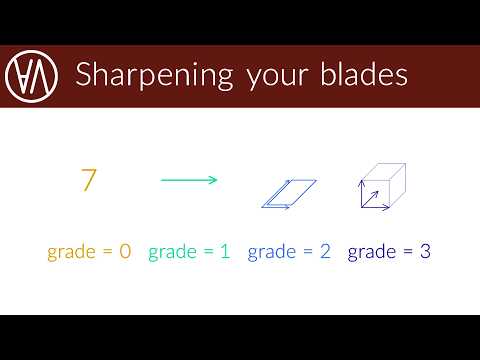
Image taken from the YouTube channel All Angles , from the video titled The wedge product | Geometric algebra episode 6 .
LaTeX Commands for Wedge and Vee Symbols
The primary LaTeX commands for the wedge and exterior product symbols are **\wedge (∧)** for the upward wedge and **\vee (∨)** for the downward vee.
In the typesetting of mathematical documents, the latex wedge product symbol is most frequently invoked using the \wedge command. This command renders the logical conjunction operator, which in the context of multilinear algebra, specifically represents the exterior product. For researchers working in Mathematical Logic vs Exterior Algebra, it is important to note that while \wedge and \land produce the same glyph, their semantic usage differs; \wedge is preferred for algebraic operations, whereas \land is traditionally reserved for logical "AND" statements.
Conversely, the \vee command generates the downward-pointing symbol used for the logical disjunction or the "join" operation in lattice theory. When moving beyond simple binary operations to operations involving sets or sequences, LaTeX provides the "big" variants. These symbols, \bigwedge and \bigvee, are designed to support limits (subscripts and superscripts) and scale dynamically based on the surrounding mathematical environment.
To ensure your document adheres to professional standards, use the following commands for specific notations:
- Standard Wedge:
\wedge– Used for the exterior product of two vectors or forms. - Standard Vee:
\vee– Used for the regressive product or logical OR. - Large Wedge:
\bigwedge– Used for the exterior power of a vector space or indexed products. - Large Vee:
\bigvee– Used for indexed joins in lattice theory. - Logic AND:
\land– A semantic alternative to the wedge for formal logic. - Logic OR:
\lor– A semantic alternative to the vee for formal logic.
The distinction between these symbols is critical when defining the properties of an exterior algebra, where the latex wedge product symbol denotes an alternating multilinear map. Mastery of these basic commands allows for the clear communication of complex structural identities in higher-dimensional mathematics.
Moving from basic symbols to structural applications.
From Cross Products to Exterior Products in Material Science
The wedge product generalizes the 3D cross product to n-dimensional spaces, allowing researchers to define oriented areas and volumes in complex material lattices.
Geometric Interpretation
In traditional vector calculus, the cross product is limited to three dimensions, producing a vector that is orthogonal to the input pair. However, in advanced material science, researchers often require a more robust framework. The latex wedge product symbol facilitates this by producing a bivector, which represents a directed area segment. This geometric interpretation is vital when modeling the orientation of crystal planes or the flow of stress through a non-isotropic medium. While standard LaTeX multiplication symbols suffice for basic vector math, exterior algebra is required for high-dimensional material modeling.
Unlike the cross product, which requires a metric to define a perpendicular vector, the wedge product is purely topological. This makes it an indispensable tool for defining the geometry of material deformation without relying on an underlying coordinate system. In a Exterior vs Cross Product comparison, the exterior product provides a way to represent "outer" multiplication that scales naturally into four or more dimensions, which is necessary for relativistic material simulations or complex phase space analysis.
Application in Tensor Analysis
Tensor analysis in material science relies heavily on the ability to construct higher-order tensors from simpler components. The wedge product allows for the creation of alternating tensors, which are used to describe physical quantities like magnetic flux density or the strain energy density in non-linear elasticity. By utilizing the latex wedge product symbol, scientists can clearly denote the anti-symmetric nature of these tensors, ensuring that the mathematical model reflects the physical reality of the material's internal forces.
When defining constitutive equations, the exterior product helps in isolating the rotational components of a transformation. This is particularly useful when analyzing the lattice rotations of a metal under stress. By focusing on the bivectors produced by the wedge product, researchers can better understand the shear mechanisms that lead to material failure or plastic deformation in complex alloys.
Contextualizing the symbol within the parent guide framework.
Typesetting Large Wedge Operators and Indices
The **\bigwedge** command is used for exterior products over a sequence of vectors or subspaces, behaving like a summation or product operator.
Subscript and Superscript Placement
When dealing with multiple vector spaces or a series of differential forms, the \bigwedge operator is the standard tool. Proper placement of indices is essential for clarity. In inline math mode, denoted by $...$, subscripts and superscripts are placed to the right of the symbol to conserve vertical space. However, in display math mode, used for centered equations, the limits are placed directly above and below the symbol, similar to the \sum or \prod operators.
Achieving the correct Operator Scaling is a matter of understanding the LaTeX math environment. If you need to force limits to appear above and below the symbol within a paragraph, you can use the \limits command, though this is generally discouraged in academic publishing as it disrupts the leading of the text. For most technical manuscripts, letting LaTeX handle the placement automatically based on the mode is the safest approach for visual consistency.
Scaling in Display Mode
Display mode ensures that the latex wedge product symbol is large enough to be distinguishable from the standard binary \wedge. This scaling is not just aesthetic; it signals to the reader that the operation is being applied over a set or a range. The table below summarizes the differences in rendering and context for these operators:
| Command | Context | Render Style |
|---|---|---|
| \wedge | Binary Operation | Inline Small |
| \bigwedge_{i=1}^{n} | Indexed Series | Display Limit |
| \bigwedge^{k} V | Exterior Power | Superscript Style |
Always use display mode for large operators to ensure proper limit alignment. This practice prevents the cluttering of complex formulas, especially when Operator Scaling must accommodate nested indices or fractional powers in the exterior algebra of a manifold.
Applying these notations to theoretical chemistry models.
Advanced Notation for Multilinear Algebra
Advanced material science simulations utilize wedge products to represent alternating multilinear forms and differential forms on manifolds.
Crystallographic Symmetries
The study of crystallography requires rigorous mathematical descriptions of symmetry groups. The wedge product is used to define the volume forms of unit cells and to calculate the wedge product of reciprocal lattice vectors. Because the wedge product is inherently alternating, it naturally captures the orientation-reversing and orientation-preserving symmetries of a crystal. This is particularly relevant when dealing with Theoretical Chemistry Tensors where the spatial arrangement of atoms dictates the electronic properties of the material.
In these advanced simulations, the latex wedge product symbol helps in formulating the equations for X-ray diffraction patterns. By representing the interaction between the incident wave and the electron density as a differential form, researchers can more accurately predict how different lattice structures will scatter radiation. The anti-symmetry of the wedge product ensures that the calculations respect the Pauli exclusion principle when modeling multi-electron systems within the crystal.
Constitutive Equations in Materials
In the realm of continuum mechanics, the wedge product is used to formulate constitutive equations that describe how a material responds to external stimuli. These equations often involve differential forms that represent physical quantities like heat flux or electric displacement. By using the exterior algebra framework, scientists can derive conservation laws that are independent of the specific coordinate system used for the simulation, leading to more robust and generalized material models.
Mastering the wedge product is essential for graduate-level research in theoretical materials modeling. Whether one is calculating the curvature of a material manifold or defining the topological defects in a liquid crystal, the latex wedge product symbol serves as the fundamental building block for expressing these complex physical relationships. The precision of LaTeX ensures that these high-level concepts are conveyed with the technical accuracy required for peer-reviewed publication.
Finalizing the technical implementation.
To see these exterior algebra symbols in action within complex equations, watch this technical walkthrough on LaTeX math mode operators.
Visual Guide to Exterior Algebra Notation
Wedge Product LaTeX Symbol FAQ
Quick answers to common questions regarding the wedge product and related multilinear notations.
What is the difference between \wedge and \land?
The LaTeX commands \wedge and \land are aliases that render the exact same mathematical symbol (∧). While they are visually identical, \wedge is the preferred semantic command for exterior algebra and wedge products, whereas \land is typically used in formal logic.
Choosing the command that matches your mathematical context ensures that your LaTeX source code remains readable and semantically accurate for other researchers.
When should I use \bigwedge instead of \wedge?
Use \bigwedge when you need to represent a large operator for a collection or range of elements, whereas \wedge is used as a binary operator between two terms. Similar to the relationship between \sum and +, \bigwedge is used for indexed products or to denote exterior powers of a vector space.
In display math mode, \bigwedge allows for the placement of limits above and below the symbol, which is essential for defining multilinear forms across complex dimensions in material science modeling.
How do wedge products differ from cross products in LaTeX documentation?
In LaTeX, the wedge product (\wedge) represents a generalized exterior product usable in any dimension, while the cross product (\times) is strictly limited to three-dimensional Euclidean space. The wedge product results in a bivector or higher-order tensor, providing a more robust framework for high-dimensional physics than the 3D-specific cross product.
For researchers bridging vector calculus and exterior algebra, using \wedge allows for the description of oriented areas and volumes that scale beyond the limitations of standard 3D vector multiplication.
Can \wedge be used for logical conjunction?
Yes, the \wedge symbol is the standard mathematical notation for logical conjunction, commonly known as the "AND" operator. Although the command \land exists specifically for this purpose, many authors use \wedge interchangeably because the output is identical.
When writing papers that involve both Boolean logic and exterior algebra, it is best practice to remain consistent with one command to maintain a clean and professional document structure.
Mastering the LaTeX wedge product symbol allows for the precise representation of exterior algebras and multilinear systems in material science research. For a complete understanding of how these advanced notations relate to foundational vector operations, return to our comprehensive guide on standard LaTeX multiplication symbols and vector typeset methods.